12 Feb 2020

4 Steps to Finding the Right Beginner Yoga Class for You


people doing yoga during daytime
Photo Credit: Unsplash 

When you are new to Yoga you are probably going to be uncertain as to what to expect when you first enter a beginner Yoga class on your first day. Most people are uncertain about what they should even be looking for in a beginner Yoga class, so this article will let you in on the four steps to finding the right class for you.


Step 1: Decide on what you want to achieve before choosing a style.
The number of different reasons for taking up Yoga is usually at least as high as the number of new people in a Yoga class. Broadly people will be looking for one of three things - physical health, mental health or spiritual health. All three are important and all three are realistic goals in a Yoga class. Whatever it is you are trying to achieve through Yoga there will be a class and style that is suitable for you. You can research in a library, online or even by asking various Yogi and this will hep you find the Yoga that will get the best result for you.

It's worth actually setting some solid goals and many newcomers are surprised at how willing a Yoga instructor is to talk over these goals with them and discuss whether they are realistic or an alternative may be better suited.

Step 2: Join a class-by-class program
These are sometimes referred to as drop in classes, or pay as you go. These are a good way of getting a feel for Yoga. There will be a regular turnover of other students in the classes and the contrasting level will mean the instructor will keep the classes at a relatively mild level and give everyone a taste of many different aspects of Yoga.

The advantage of this method is of course that you are not committed to an expensive series of classes and you can get a taster for Yoga and see what types of Yoga interest you. You will also quickly learn whether the goals you set earlier are realistic for you, or even too low and need expanding upon.

Your next step will be to chose a series of classes in the areas that you found most suitable from the drop in classes. These classes will build on each other from week to week and you may find yourself behind if you miss a week.

Step 3: Ensure that you are being taught by someone who knows what they are doing.
Surprisingly enough considering the relatively low intensity and the many physical benefits, Yoga has begun to regularly show up on the statistics for sports injuries. Two key causes are identified. Firstly students pushing themselves too fast too soon, and secondly instructors with inadequate training or appreciation of the individual level of their students(large classes are sometimes to blame for this).

When you are considering a new class, don't be embarrassed to ask your Yoga instructor what their qualifications and background are. Many 'instructors have nothing more than a three day training course in 'gym yoga' and many people put this in the 'enough knowledge to be dangerous category'. Traditionally a student would train for many years under a guru before they would be considered fit to pass on even the simplest of Yoga techniques to another novice.

A nice rule to work by is that less than 200 hours of instruction would mean a part time Yoga education. 


Step 4: Be aware of hidden costs.
An unpleasant surprise that can put people off Yoga is turning up to the first class and finding that there are expenses that they weren't expecting. Some studios require each student to have their own mat, a special strap or other props. Some classes will work through a book which you are obliged to buy and some classes will have a dress code ranging from specific colours to specific articles of clothing. So be sure to ask questions on what you may need for the class.


5 Feb 2020

6 Benefits of Bikram Yoga

File:Bikram teaching.jpg - Wikimedia Commons

Bikram Yoga is intended to scientifically warm up and stretch tendons, ligaments, and muscles in the proper order that they should be performed, with twenty six series of challenging asanas.  Designed by Bikram Choudhury, these twenty six series of Bikram Yoga posture exercises methodically move oxygenated, fresh blood to the entire body, to every fiber and organ, repairing every single system to a healthy working condition, as nature has designed it to be; the result, toned muscles, proper weight, great sense of well-being, and an energetic good health.


There are numerous benefits of Bikram Yoga and its twenty six asanas; however, here are some of the most asked about areas on benefits of Bikram Yoga postures:


Pranayama Breathing
This gives mental relaxation, and works on the respiratory, circulatory, and nervous systems of the body, as well as detoxification of the body.


Half Moon Pose
This posture helps ease constipation, lower back pain, bronchi stress, stomach obesity, frozen shoulders, and scoliotic deformities.  Other benefits of Bikram Yoga half moon pose include working out the pancreas, colon, and kidneys, as well as working on the trapezius, hamstrings, deltoid, and pectoralis major.


Eagle Pose
The benefits of Bikram Yoga eagle pose includes helping the pelvic area to open, alleviating knee arthritis and joint pain, strengthening the lower limbs, relieving sciatica, and improving flexibility of the ankles and toes.  It also works on the deltoids and quadriceps.


Standing Bow Pose
This Bikram Yoga posture boosts circulation to the lungs and heart, perks up spine elasticity through spine compressing, assists with lower back pain, and opens lungs and diaphragm.


Triangle Pose
This Bikram Yoga pose is good for the kidneys, and it helps in chemical imbalances of the system, as well as helping in alleviate constipation, colitis, spondilitis, menstrual disorders, hip and back pain.  It also gives cardiovascular benefits, as well as working on the circulatory, immune, muscular, digestive, and reproductive systems.

Tree Pose
The tree pose creates knee and hip mobility, helps alleviate inflammation of the lower back, and releases tension of the abdominals.


Toe Stand
This Bikram Yoga posture creates balance in mind and body, strengthens weak joints and stomach muscles, as well as helps with knee problems, arthritis, or gout problems.


These are just some of the benefits of Bikram Yoga postures which deliver total health through strengthening and balancing every system of the body to prevent injury, illness, and limit the effects of aging. 

29 Jan 2020

3 Common Mistakes by Yoga Newcomers

Whenever we start something new we have a certain feeling of trepidation and uncertainty of the unknown and in most cases it is completely unfounded and we get on with things very quickly and easily.  Sometimes it isn’t and a simple little thing can cause us to have an entirely negative first impression and perhaps even never want to try that activity or pastime again. Yoga has so many health benefits, on both a physical and spiritual level, that it would be a tragedy for anyone to miss out on them because they made a silly avoidable mistake on their first day.  With that in mind this article addresses the 3 most common mistakes of new Yogi, and how to make sure they don't happen to you.

Mistake One:  Not knowing what you want from Yoga.

The reality is that there are numerous different styles and forms of Yoga and each has it's different attractions.  Ask yourself what it was about Yoga in general that attracted you and then you can investigate a style that caters more specifically to that.  You may like to set goals, be they physical, mental or spiritual. If you do then it's a good idea to discuss them with the instructor of your class before you begin.  Yoga instructors are usually very approachable and happy to talk about their passion. They will be able to talk to you about your goals for the class and let you know if you are being realistic, aiming too high or too low.  Make sure your goal includes a time-frame so it becomes something that is measurable.

Mistake Two:  Jumping in Feet First.

Having decided that they will give this Yoga thing a try many people take a running leap and jump in to a 12 month stage by stage class.  These classes are usually an upfront payment arrangement and progress from one level to the next as the weeks progress. They are a fantastic way of learning Yoga and becoming very good at it, but it's quite possibly you will choose a class that is not ideal for you.
  
  The best way around this is to join a Yoga beginner class, also known as a drop in class.  If you do these classes for a few weeks you will notice a high turnover of students as new people join and old people move on.  These classes are designed to give you a very broad feel for the different types of Yoga. The level of the students in the class usually varies greatly so you can expect the instructor to keep the classes quite tame.  The other key benefit of doing this is that the classes are pay as you go so there is no big financial outlay for you while you decide the type and style of yoga that best suits you. You are also not obliged to attend every class.  With the longer courses you can fall behind quickly if you miss a week or two in a row. With the pay as you go classes you will find that while each class is different the level stays quite low to cater for the newer people joining in.

Mistake Three:  Choosing the wrong teacher.

  Traditionally a Yogi had to be an apprentice to a skilled Guru for many years before he could teach even the simplest of Yoga technique.  Nowadays a 3-day course over a long weekend is considered enough by some people. There is a big difference in what you will achieve depending on the skills and abilities of the person teaching you.  Yoga is starting to make a regular appearance on the sports injury list and a large reason for this is instructors who have been taught just enough to be dangerous. A qualified teacher won't necessarily be fantastic and an unqualified teacher won't necessarily be terrible - but the odds are certainly cast in that direction, so it's a good idea to check your instructors background and qualifications before you begin studying with them.

22 Jan 2020

Vegetarian Burrito Bowl

vegetarian burrito bowl in white bowl on dish towel
Credit:chiselandfork.com

Ingredients

olive oil, divided
sweet potatoes
chili powder
cumin
paprika
garlic powder
kosher salt
black pepper
green bell pepper
red bell pepper
large white onion
 black beans
long grain brown rice
salsa verde
corn
cherry tomatoes
guacamole
chopped cilantro and limes for garnish

Get the full recipe here

15 Jan 2020

5 Refreshing Dragon Fruit Smoothie Recipes

A beautiful bright pink dragon fruit smoothie in a glass, garnished with mint, lime, and white dragon fruit,
Credit: sunkissedkitchen.com

Ingredients: 
dragon fruit, mango, bananas, almond milk, lime juice, protein powder, ice cubes

Get the full recipe here
~
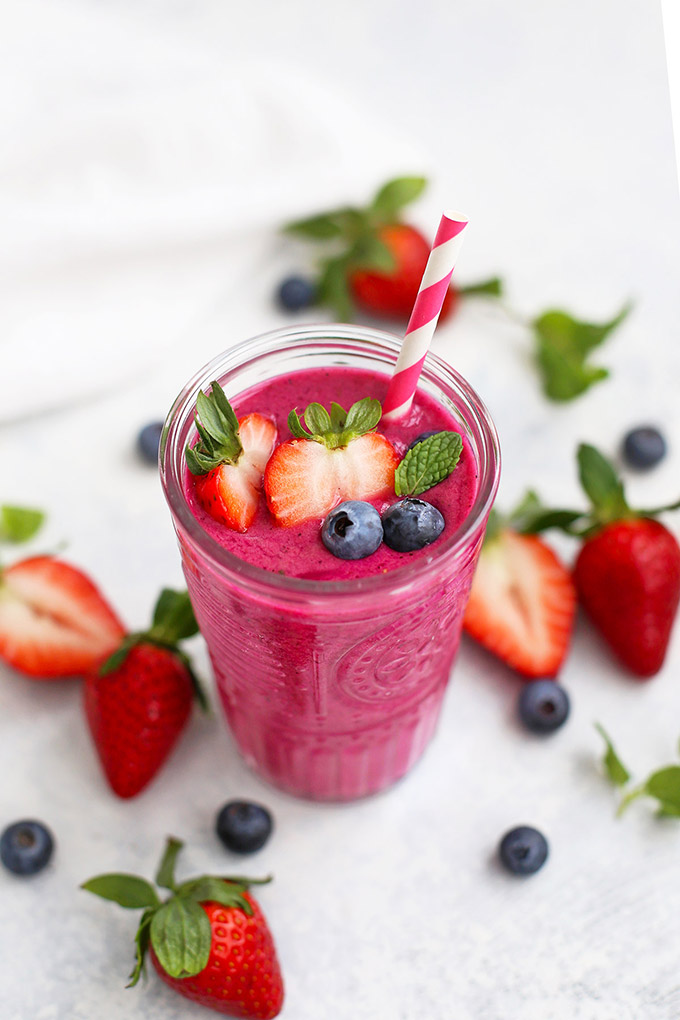
Credit: dragon fruit smoothie

Ingredients: frozen berry mix, gala apple,
frozen dragon fruit, strawberries, banana, vanilla flavoured yogurt, almond milk, maple syrup, ice

Full recipe here
Dragon Fruit smoothie in 3 glasses topped with goji berries and coconut
Credit: dragon fruit goji berry smoothie

Ingredients: dragon fruit, bananas, frozen raspberries, unsweetened almond milk, goji berries, coconut shavings. Get the full recipe here  
Tropical Strawberry Pitaya Smoothie - This pretty dragonfruit smoothie is so delicious! My whole family loves it! (Paleo or vegan)
Credit: Tropical Strawberry Dragon Fruit Smoothie
Ingredients: frozen dragon fruit, frozen strawberries, frozen mango, frozen pineapple, chia seeds, spinach, orange juice, almond milk or water. Get the full recipe here
~
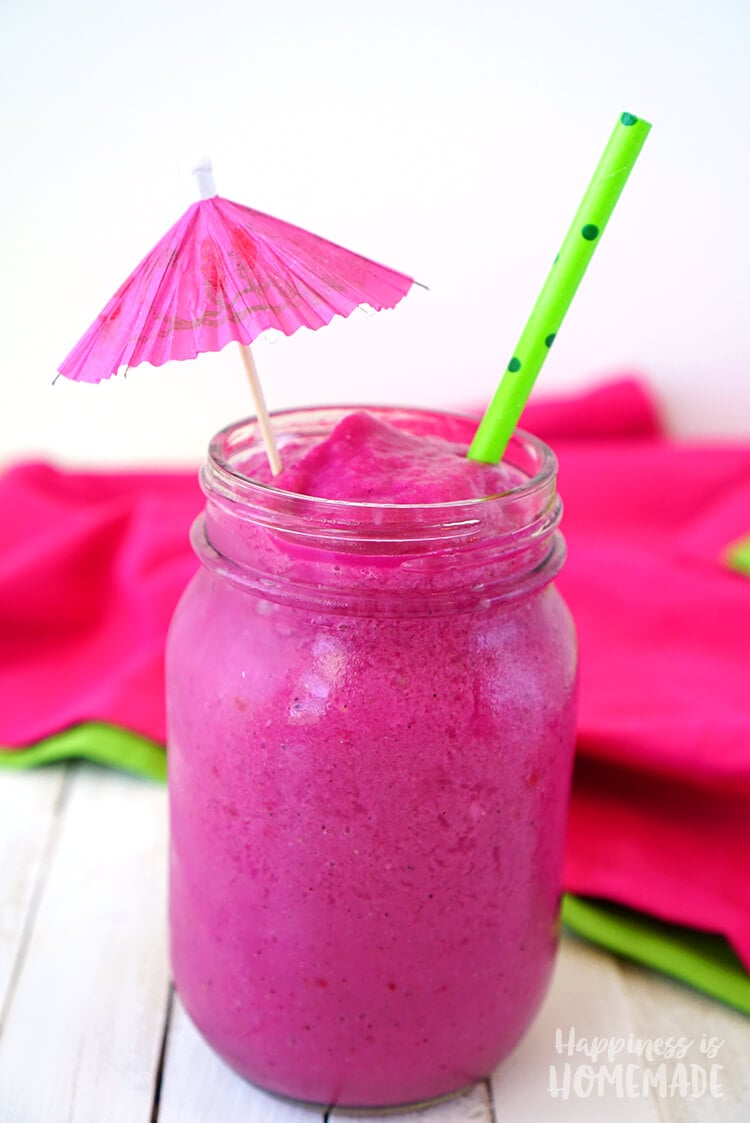
Watermelon Dragon Fruit Pitaya Smoothie
Credit+ Full recipe : Watermelon Dragon Fruit Smoothie

Ingredients
white grape juice, strawberries, watermelon , dragon fruit, vegan plain yogurt (sub ingredient), ice Get the full recipe here